
Precision Diagnostics to Enable a New Era of Targeted Therapies and Personalized Medicine
Switch-Blockers have a distinctly different configuration than standard blockers such as CAST PCR and this configuration is why Switch-Blockers have higher performance characteristics. To be genome-specific, CAST PCR or other standard blockers need to be 18-30 bases in length, but this means they are tolerant to single base mismatches, often only able to have 1°C thermal discrimination between wild-type DNA and mutated DNA. This small thermal discrimination results in the polymerase occasionally extending through the wildtype allele. This amplicon error amplifies across the cycles, resulting in false positives.
Switch-Blocker oligos consist of three segments: the Anchor (which provides specificity and is like a vice grip clamping down on the target DNA region), the Bridge (bridges between both ends of the oligo) and the Switch (which is wildly destabilized in the presence of a point mutation). Switch-blockers are efficient at suppressing normal DNA as the switch provides around 20°C of thermal discrimination. This results in far fewer false–positive compared to CAST PCR or other blockers.
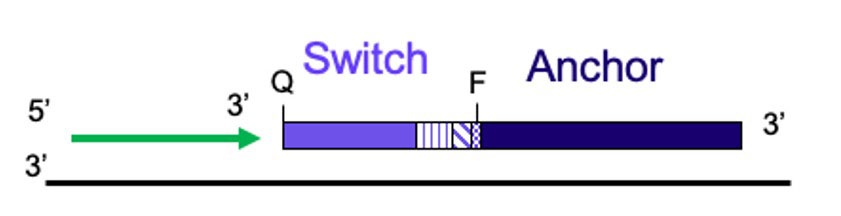
Suppresses normal (non-mutated) DNA amplification — noise reduction
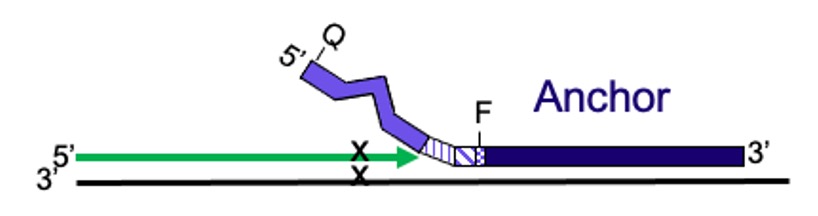
Anchor generates increased local concentration of Switch-Blocker™ at site of mutation detection, and Switch is highly unstable in presence of point mutation
Mutant allele frequency (MAF) is the proportion of DNA molecules in a sample that contain a specific mutation. Reimbursement for clinical assays in many cases requires 0.1% MAF. Standard PCR, qPCR, and NGS often only reach 1%. In this Switch-Blocker assay for activating plasma EGRF (L858) with 112 positive NSCLC patient samples, MAF >0.01% was achieved.
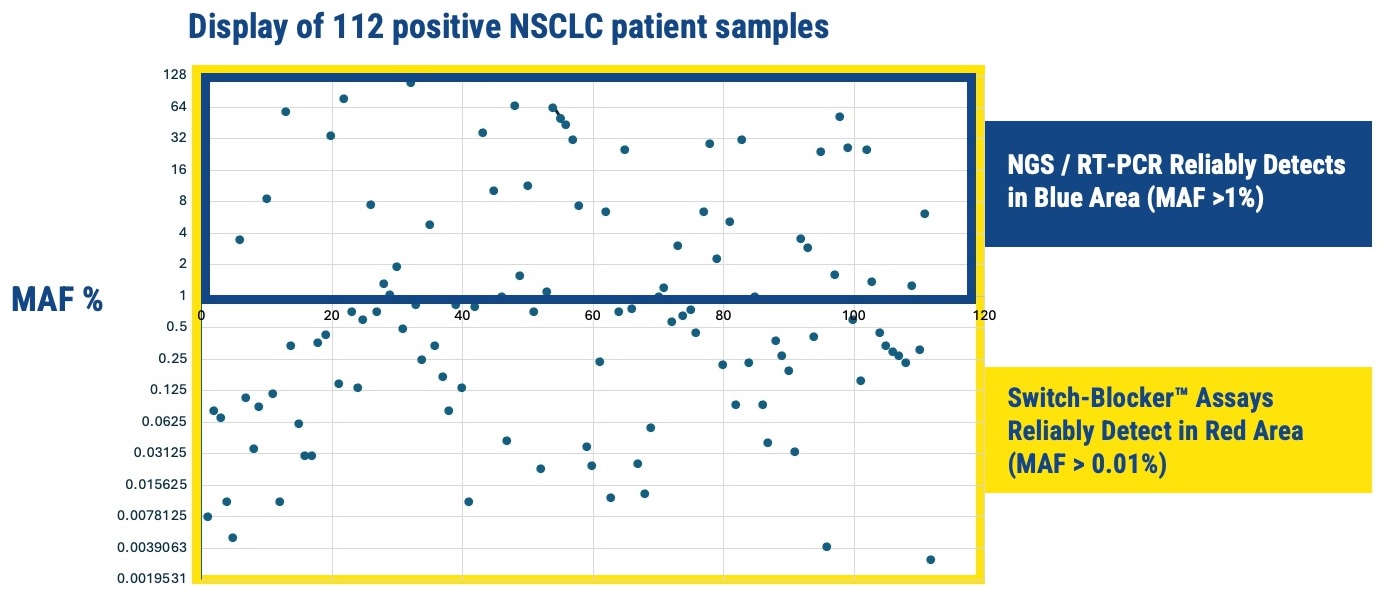
Poole JC, Wu SF, Lu TT, Vibat CRT, Pham A, et al. (2019) PLOS ONE 14(10): e0223112
Arnold L, Alexiadis V, watanaskul T, et alJournal of Clinical Pathology 2020;73:648-655.
Switch-Blocker is Aegea’s patented nucleic acid chemistry that enhances the sensitivity and specificity of molecular diagnostics. It functions by suppressing wild-type (or normal DNA) sequences while selectively amplifying rare mutations, enabling detection of genetic variants at frequencies below 0.01%—ideal for applications like oncology, infectious disease testing, transplantation, and personalized medicine.
By enriching mutant sequences and blocking wild-type amplification, Switch-Blocker reduces background noise and increases signal clarity. This results in faster, more accurate, cost-effective assays that can be seamlessly integrated into existing PCR and Next Generation Sequencing (NGS) workflows without the need for new instrumentation.
Aegea’s platform is capable of detecting a wide array of genetic alterations, including single nucleotide polymorphisms (SNPs), insertions, deletions, and other rare mutations. Switch-blockers specialize in identifying low abundance, clinically relevant somatic mutations present in highly degraded samples or fragmented DNA like liquid biopsies. Proven examples of these include mutations in genes such as EGFR, KRAS, and ESR1 which are pivotal in cancer diagnostics and treatment planning.
Absolutely. Aegea has applied its Switch-Blocker technology to develop highly sensitive PCR-based COVID-19 assays capable of distinguishing viral strains and quantifying viral load. These assays can be rapidly customized for emerging variants and other pathogens.